Sunday, February 12, 2012

The Red Scare of 1919-1920

Most Americans are familiar with the "Red Scare" from the cold war era, but I'm sure many Americans would be surprised to find out that there was another Red Scare in the years 1919 and 1920. The Red Scare started because of a sudden spread in Bolshevism. This sudden overflow of Bolshevik thinkers instilled a fear in many people of their radical political beliefs would lead to a revolution and their "free America" would be in jeopardy. The Red Scare had an impact on the American culture of the time in more ways then I thought it did. In many ways, the people that were afraid of radical political beliefs, actually became what they feared by being so closed-minded. The Red Scare had an affect on the American culture and the American people by causing public outcry for drastic anti-communist action, electing leaders with anti-communist agendas, not responding to violence, and not having the appropriate reaction to anarchism.

When I first started researching how the average American citizen viewed the first Red Scare, I came across an article through AVl, The 'Red Scare' Threatens Personal Liberties, and this article explains the public outcry for government action.  According to this article, people were "clamoring for some kind of government action in response to the 'conspiracy.'" The fact that an author felt it appropriate to use the word "conspiracy" when describing a type of government, helps drive home my point that the American people were becoming more and more closed-minded as what they were trying to prevent! The want for government action lead to the arrests of thousands of socialists and suspected socialists. 


This type of action is exactly what I was referring to when I said that the American people were becoming as closed-minded as the people that they were trying to defend against. The KGB was notorious for arresting people suspected of anti-state actions, don't these raids of "communists" draw many similarities to the KGB arresting innocent people in Russia?! 

Through my research, I came across many political leaders that seemed to get elected based solely off of their anti-communist platforms. The most interesting, I think, is the Governor of New York, Alfred E. Smith. Governor Alfred E. Smith and the Red Scare of 1919 is an article I found on JSTOR, written about Smith and how he viewed the increased in people with Bolshevik morals. One of the most famous actions of Smith is getting rid of 5 members of the New York State Government because the belonged to the Communist party. It was this type of action that led to a change of atmosphere in America. To my surprise, people were okay with him getting rid of those elected officials! It was leaders like Governor Smith, that heightened the irrational fear of Communism. 
According to this article that I found on JSTOR, A Study of Nativism, the American people even tolerated violence if the victim was a suspected communist! Under any situation, violence should never be tolerated, communist or not! The government sent the wrong message to the American by not responding to open acts of violence. This lack of action led to a change of the American culture. Violence became an appropriate reaction if you suspected someone of being a Communist or having Bolshevik beliefs. Why violence was an appropriate answer, is beyond me. When I read that violence was typical in this time period, I was disgusted to find out to what extent. I found out (from the Article above) that a sailor shot a man 3 times in the back, and faced no consequences. That's just not acceptable! 

At one point or another countries will typically face some version of uprising. The American government did not respond appropriately when faced with the rise in anarchism. Instead of being rational, the government took major steps, or in some case, a lack of action, to make sure that communists didn't gain any power. The government didn't respond to violence, the government arrested thousands of people, and the government didn't accept people with different beliefs. They were becoming just like the new Russian government. The government decided it would be appropriate to use propaganda, like the Russians, to motivate people to spread the love for capitalism!
Propaganda Poster 1
Propaganda Poster 3
Propaganda Poster 2


 This change in tone from the American public ironically led to the American government and American citizens becoming what the feared. I found it quite amusing! I drew a lot of similarities from that time, to the political atmosphere today. Maybe if the spread of Bolshevism was handled differently, violence wouldn't have been acceptable, maybe thousands of people wouldn't have been arrested, and maybe those New York officials could have kept their jobs. I find it sad that many Americans today, including myself until just recently, don't know about this Red Scare. We should look at the mistakes we, as a country, made in the past, and grow.

Tuesday, January 31, 2012

WWI Post thing

Something I wanted to learn more about was if soldiers kept diaries with poetry, is if some soldiers kept drawings in their notebooks. John Sheller kept cartoons in his notebook that kind of described his time in the war.
Yeah, here they are.

Friday, January 13, 2012

And more progress about the Great White Fleet

So here is the link and junk. Click here. Right here. Now. Cool.

The ships had 14,000 sailors.
Common opinion was that America was doing this to "bluff and "bombast" about our superiority and basically prove that America is the best.

Thursday, January 12, 2012

Progress on the Great White Fleet

In Australia, half a million people turned out to see the Great White Fleet.
Before this, no battleship had ever been to Australia so this brought up issues of defense with the people of Australia. This is what the Aussies thought.

Monday, November 7, 2011

Art and Advertising in the 1920s and 1930s

The early 20th century was one of the most progressive eras in history. There were social, political, and scientific advancements that had a direct impact on the average person's day to day life. One area that made giant advancements that is often over-looked is art and advertising.  There were drastic changes in the arts. The arts were often looked at as being something that was unnecessary and encouraged people to be slothful. But with the changes that came in the early 20th century, art became something that the average person would be exposed to on a daily basis. A reason that art and advertising changed was becomes the public view on art changed. People started to attend movies, art exhibits, and civic art projects more often. The styles and techniques used in the early 20th century in art and advertising differ from the styles used in the decades directly prior in the way companies and cities branded themselves, the way they advertised, and the public view on civic art. 

Before the turn of the century, companies ways of branding themselves did not vary very much. The logos were often ornate and used very sophisticated fonts. These ornate styles were often lacking in color, as well. Today, companies take full advantage of shading, varying colors, and differentiating themselves from the competition. You first start to see these techniques used in abundance in the 20s and 30s.  The Coca-Cola company is a prime example of a company that rebranded itself in this time period. Before, Coca-Cola used many serifs and used hard edges to attempt to make themselves stand out. However, when they rebranded themselves and took a more modern, "simplistic" approach they get ride of all serifs, make the design have rounded edges, and use a bubble style. This new style is meant to grab the consumers eye and entice him to buy the companies product or go to the advertised event. This new way of advertising had a direct impact on the way companies advertised their new products and events. 


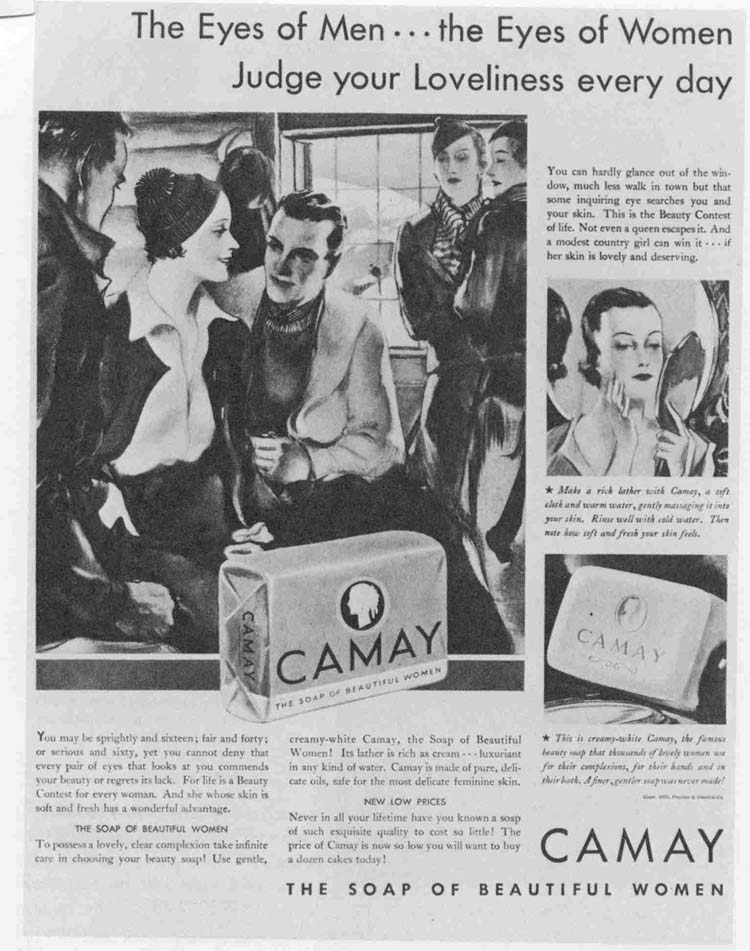
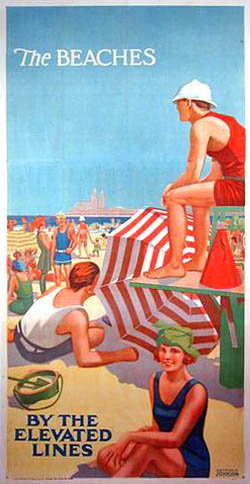
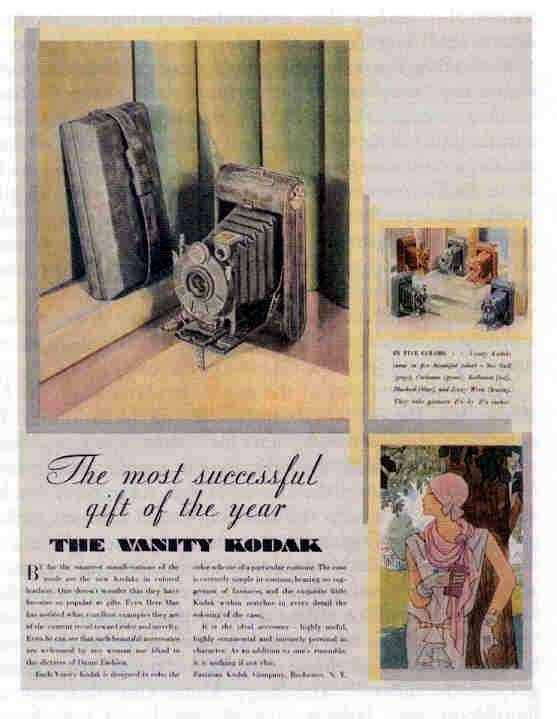
The way that companies advertised products changed drastically in this time period. Before the simplistic style became so widespread advertisements would take up huge amounts of space with very little fonts that included all information possible about the event or product. The ads were often crowded and not very aesthetically pleasing. This Camay Soap ad is a perfect example of this style that squished all the information. This style made consumers have to work to get all the information out of these advertisements. This advertisement also uses only black and white and takes full advantage of shading, which is different then how the designers of the minimalistic posters took full advantage of color at every opportunity. This poster made for "The Beaches" is a great example of the minimalist style that comes from the early 20s. This advertisement takes advantage of colors that are well used, using complementary color schemes, and also only uses a little bit of text. The advertisement only states what exactly it is advertising and who it is by. Although there are some companies that knew they needed to change with the times but they also felt that the old style had its perks. This advertisement used by Kodak illustrates an interesting combination of the two styles. It has minimalist style illustrations that use color and a good use of color patterns by using gradients, monochromatic and complementary color schemes. The changes in advertising illustrated by these three advertisements had an impact on how people viewed art because of how often they were exposed to it. 


  Many cities used Civic art as a way to advertise their cities and entice people to visit and move to their cities. Cities like Chicago and Philadelphia took full advantage of this. These public art projects Helped changed the public view on art and the affect it could have on people. Cities that used this new style of art did so mostly because of a new widespread interest by the average citizen to see art in their city.  Cities also used these civic projects to make the city itself more aesthetically pleasing. The used these projects to help with city planning. Many people would not consider the beautification of cities, "artwork" but the civic art projects that were paid for by the city in hopes that it would make their city look better fits into the definition of art, "any field using the skills or techniques of art."  The change in style of city planning had direct impacts on people's lives. Large cities like Chicago, Philadelphia, Minneapolis and Cincinnati were directly affected by this new public interest in art. 

The beautification of cities and towns,  the change in styles in advertisements, and the rebranding of companies are all evidence of the different styles used and the change in attitude towards are in this time period. Art was no longer considered something for the high class that was only to be seen by them. It was no longer just private collections, but rather something to be enjoyed by all. Art was made more public, it was used around cities as well as in them. It was in this time where we first start seeing art become what it is today, something to be shared and loved by everyone. 

Thursday, November 3, 2011

Art and Marketing in the 20s

While I've been studying the change in marketing during the 20s I've found that there was a very dramatic change from the style commonly used in the late 19th century and the early 20th century.

The late 19th century style was very ornate. The style take full advantage of serifs at every opportunity.
This Pepsi logo is from the Pepsi Cola company from the very late 19th century. 

The early 20th century logos take more of a curved and more simplistic style. The don't use fonts that are nearly as ornate and eye catching. The take a very modern approach that "simple is better."

This Pepsi logo is from the Pepsi Cola company from the 1920's.